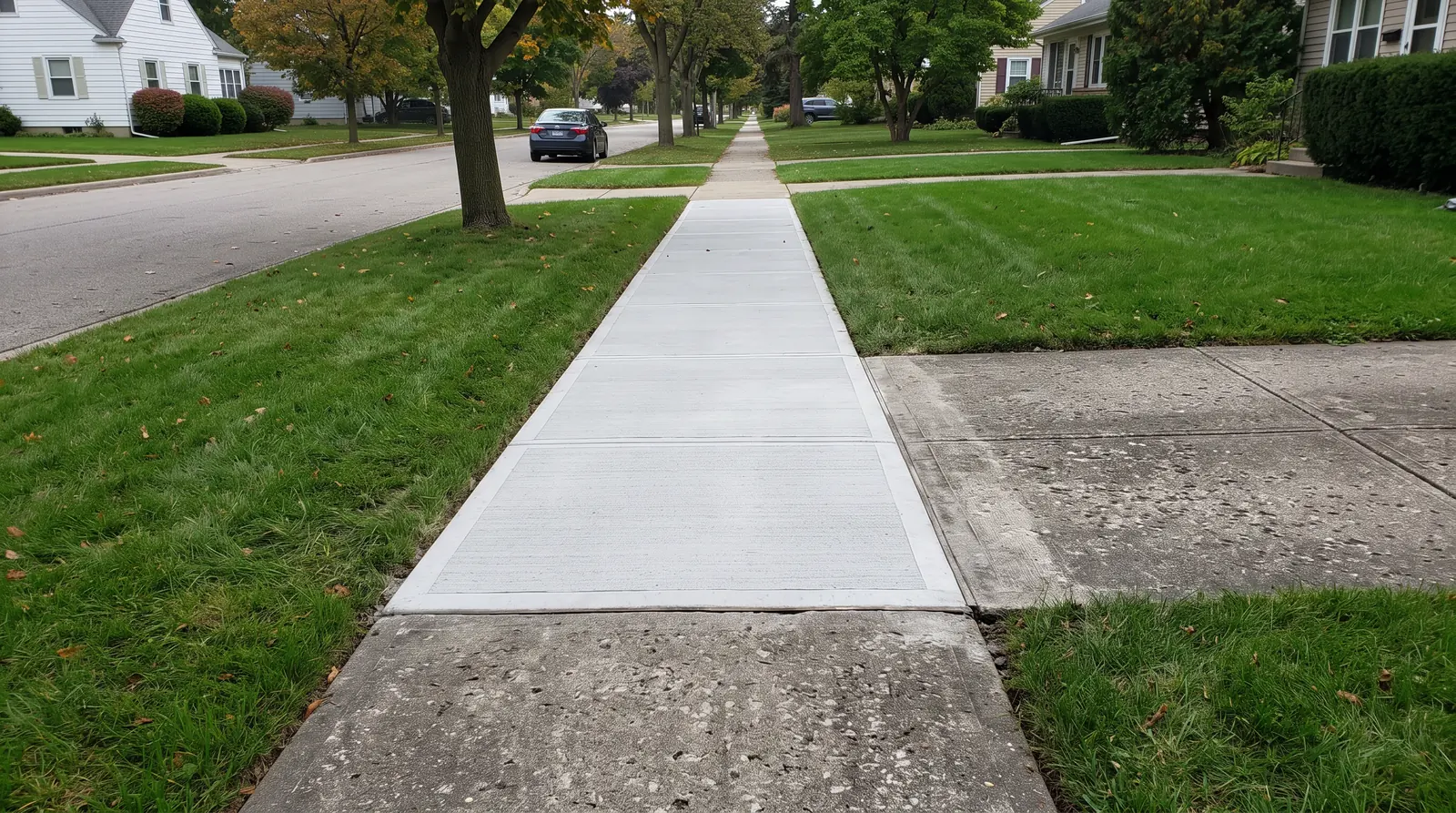
Sidewalks & Walkways in Evanston, IL
Public sidewalk squares, front paths, and side yard walkways. We know the city's cost share rules as well as we know the concrete.
Sidewalk Repair and Replacement in Evanston
Here is the fact that reframes every sidewalk conversation in this town: under Evanston's city code, maintaining the public sidewalk beside your property is the adjacent owner's responsibility, not the city's. The city's own program documents say it plainly, and the adopted property maintenance code extends the same duty to private walks and driveways on your lot. When a square in front of your house heaves, cracks apart, or scales into gravel, that is your problem to solve, with or without the city's help.
The scale of the backlog explains why. Evanston maintains about 280 miles of public sidewalk, and by the city's own assessment roughly 19 miles of it needs repair. A homeowner waiting for all of that to be fixed around them is going to wait a long time. The good news is that Evanston, almost uniquely among nearby towns, will pay half your replacement cost when your squares qualify.
Evanston's 50/50 Sidewalk Replacement Program
The deal is simple: for squares that meet the city's eligibility criteria, the city pays half the replacement cost and the homeowner pays the other half. In 2026 the homeowner share is $8.40 per square foot, which works out to $222.60 for a typical sidewalk square. The mechanics are almost charmingly analog. You mark the squares you think qualify, you contact 311, and city staff come out and inspect each one against the criteria below.
Timing matters. Signups run in a spring window each year, and the 2026 window closed on May 8. Squares accepted into the program are typically replaced across the summer construction season. If you miss the window, or your squares fail the criteria but still bother you, private replacement is the path, and that is where we come in.
| Qualifying defect | What it looks like from your porch |
|---|---|
| Vertical displacement of about half an inch or more | One square sits proud of its neighbor, the classic toe catcher |
| Abrupt slope change across the whole square | The square tilted as a unit, usually lifted by a root or a washout |
| Broken into three or more pieces with cracks a quarter inch or wider | A spiderwebbed square that shifts underfoot |
| Spalling or scaling on a third or more of the surface | The finish has flaked off and exposed the aggregate, salt's signature |
| ADA accessibility improvement needed | The square blocks a wheelchair or stroller from a safe, level route |
One more square to check: the city patches reported trip hazards with temporary asphalt, typically within two or three days of a 311 report. A black asphalt wedge on your walk is a bookmark, not a repair.
Private Walkways and Front Paths
Off the public strip, walkways are where concrete earns its keep daily: the front path to the porch, the side yard run between front and back, the pad at the base of the stoop. Evanston's older housing stock often came with a 24 inch ribbon walk that modern life has outgrown. We build them at usable widths, pitched a quarter inch per foot so meltwater sheets off instead of ponding into an ice patch, with a broom finish for traction and joints spaced so cracks happen where we planned them.
Side yard walks deserve special mention because they solve drainage problems as often as walking problems. A properly pitched walk along the house moves water away from the foundation on ground that otherwise stays soft half the year. And where a front path meets the house, the stoop is usually aging on the same schedule; repairing or repouring concrete steps and stoops in the same mobilization is the efficient way to do both.
Added a concrete walkway along the side of our home to connect the front and backyard. It made moving around easier.
Trees, Permits, and Parkway Rules
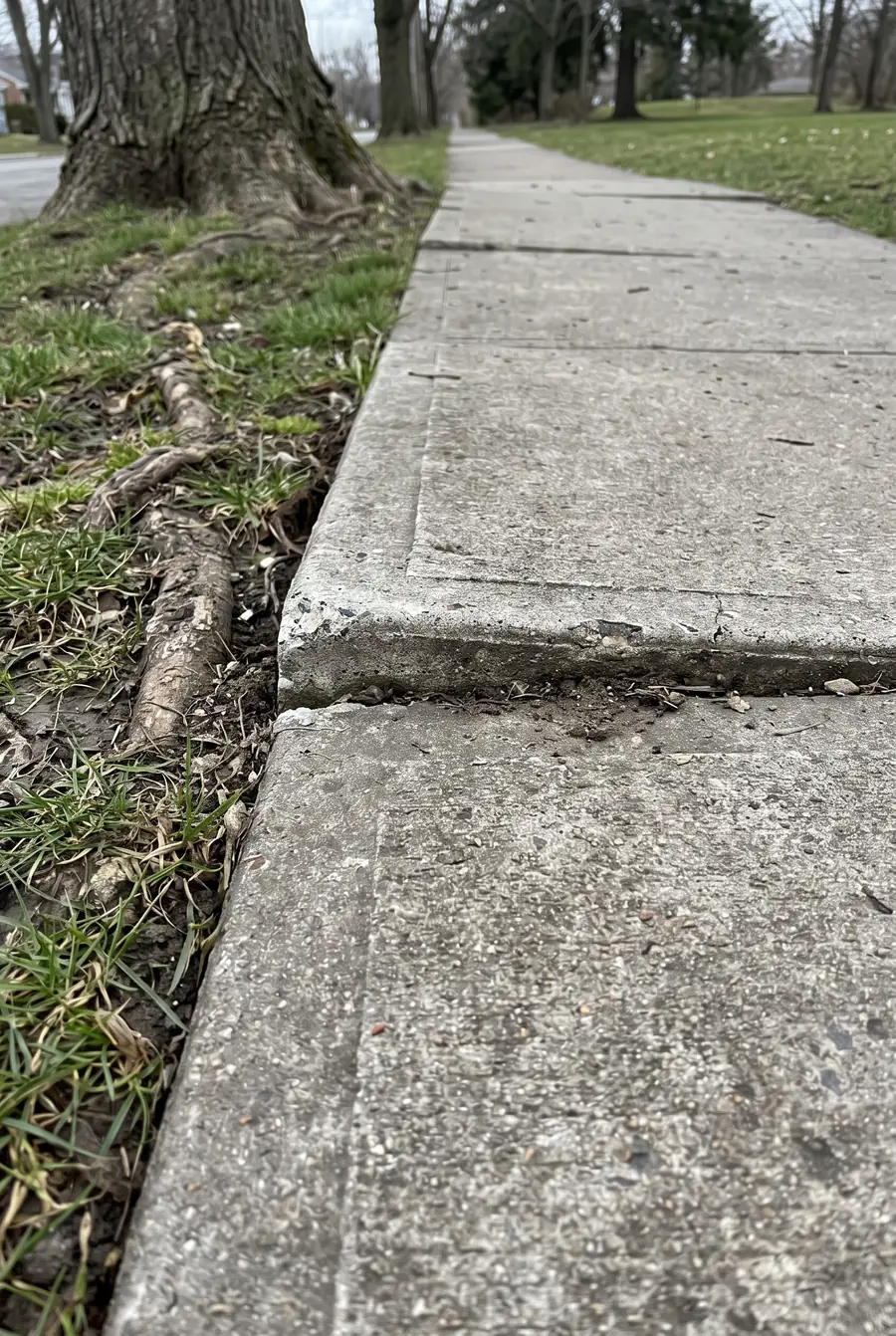
Evanston's tree canopy is one of the best things about walking here, and since June 2024 it has real teeth in the permit process. Under ordinance 15-O-23, any exterior project within 25 feet of any tree, public or private, needs a Tree Preservation Permit, and the protected zone explicitly includes the roots, not just the trunk. The permit runs $80 to $100 and requires a diagram showing the work and every tree within 25 feet, including your neighbor's. Almost every sidewalk and walkway job in this town is within 25 feet of a tree, so this is not a corner case, it is the default.
That changes how root heaved walks get fixed. Cutting a parkway tree's root to flatten a square is exactly what the ordinance exists to prevent. The durable fixes are rebuilding the walk with the grade eased over the root or spanning the root zone so the tree and the walk stop fighting. We design around the tree, pull the permit, and the walk stays fixed instead of heaving again in three seasons.
Where a walkway project touches the parkway or a driveway apron, the city's right of way rules apply, including the separate permit and the winter moratorium. We cover those on the driveway aprons and parkway permits section of our driveways page.
Snow, Salt, and How Long Sidewalks Last
Evanston's snow ordinance gives owners 24 hours after snowfall ends to clear a 36 inch path, so sidewalks here get shoveled and salted more than almost any other concrete on the property. Meanwhile the city treats 190 lane miles of streets, laying anti icing brine roughly 8 hours before a storm, and every car that pulls into a driveway drags that chemistry across the walk.
Salt does not dissolve concrete like acid. It supercharges freeze thaw damage by keeping water liquid at lower temperatures and pulling it into the surface, where the next hard freeze pops the finish off. That is the spalling in the eligibility table above, and it is why the durable sidewalk recipe here is boring and non negotiable: air entrained mix, a proper cure before the first winter, and sand instead of salt for the first season. A square built that way shrugs off decades of shoveling.
Marked Squares? Failed the Criteria? Either Way.
Whether the city is paying half or the whole run is on you, start with a written estimate that maps square by square what actually needs replacement.
(847) 380-8138What Sidewalk Work Costs
The city's program gives Evanston homeowners a rare thing in construction: a published benchmark. $8.40 per square foot is the homeowner half in 2026, so the city's effective all in rate for straightforward public squares is about $16.80 per square foot. Private work runs above municipal pricing because a crew mobilizes for your squares alone rather than a summer long citywide contract, and because residential jobs carry access, tree, and grade complications the city contract averages away. But that number is your anchor. A private bid in the same neighborhood as the city's math is a fair bid; one several times it needs to explain itself.
What moves walkway pricing: total square footage, tear out and hauling, base condition, how much grading the drainage fix requires, and the finish. A front path and a 50 foot side run priced together almost always beat two separate mobilizations, which is worth knowing if both are on your list. Connecting a walkway into a backyard concrete patio in the same pour is the same logic at larger scale.
Evanston Sidewalk Questions
Under Evanston's city code, maintaining the sidewalk next to your property is the adjacent owner's responsibility. The city's 50/50 program splits replacement cost with you when squares meet the eligibility criteria, and the city also runs its own fully funded replacement program that works through a citywide priority list on its own schedule.
You mark the squares you believe qualify, contact 311, and city staff inspect them against the eligibility criteria. Signups run in a spring window each year, and accepted squares are typically replaced over the summer construction season. Miss the window and the work waits a year, or you hire the replacement done privately.
Not without the city involved. Evanston requires a Tree Preservation Permit for exterior work within 25 feet of any tree, public or private, and the protection explicitly includes roots. The right fix is usually rebuilding the walk to accommodate the root or bridging over it, decided with the permit in hand, not a chainsaw.
If most squares are sound, replacing the failed ones is the efficient move, and it is how the city's own program works. When more than roughly a third of the run is cracked, settled, or scaling, per square replacement starts costing more than it saves, and a full run gives you consistent grade, joints, and appearance.
Sometimes. Lifting works when a sound, uncracked square has settled and the base under it can be filled. It does not fix squares that are cracked into pieces, scaling from salt, or heaved by roots, and lifted squares do not always stay put in freeze thaw ground. We will tell you honestly which category yours is in.
Walkways are also where decorative finishes make sense at small scale. Exposed aggregate and stamped textures for paths are covered under decorative walkway finishes.
Get Your Squares Priced
Tell us how many squares or how long the run is, and whether the city has already marked anything. We will inspect, tell you what the 50/50 program will and will not cover, and put the private price in writing.
(847) 380-8138, Monday to Friday 8am to 5pm, Saturday 9am to 3pm.
Get a Free Estimate
Tell us about the project and we will get back to you within one business day. Prefer to talk? Call or text (847) 380-8138.