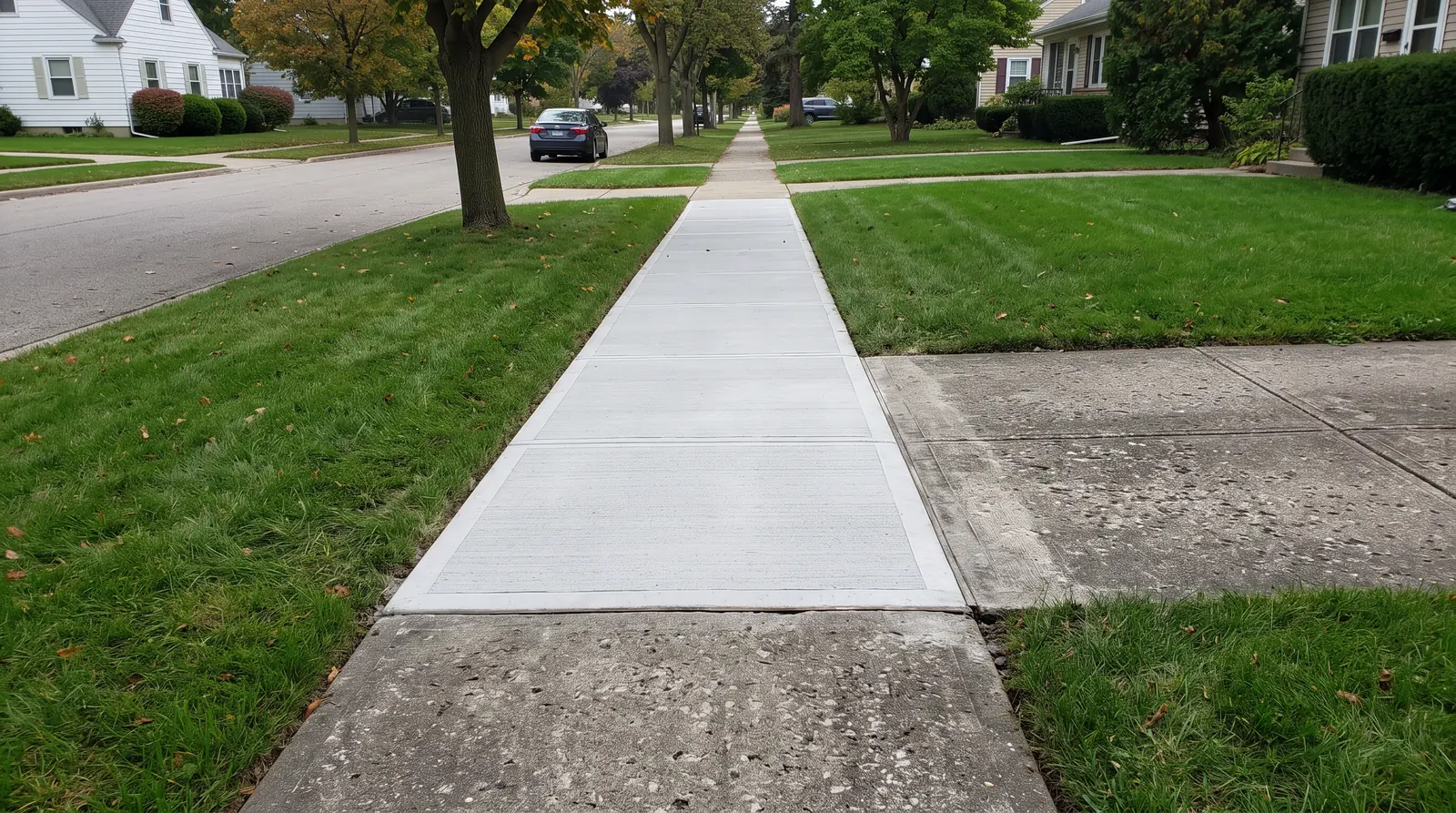
Concrete Leveling and Mudjacking: An Evanston Homeowner's Guide
A sunken slab can often be raised for less than a new one. Sometimes it cannot, and paying for a lift first just delays the replacement. Six questions sort out which one you have.
Is Your Slab a Candidate for Concrete Lifting?
Concrete leveling, mudjacking, slab jacking, concrete jacking and foam lifting all do the same basic thing: fill the empty space under a sunken slab and push it back up. Plenty of people call it cement leveling, too. Whatever the name, it only works on the right slab. Go down this list with the slab in front of you.
- It is still one solid piece. It rocks or tips as a unit, with no loose chunks.Broken into several pieces that move separately: there is nothing solid to lift. That is a replacement.
- The surface is sound. Scrape it with a screwdriver and it stays hard.Flaking, scaling or crumbling deep down: lifting puts a bad surface back at the right height. Replace it.
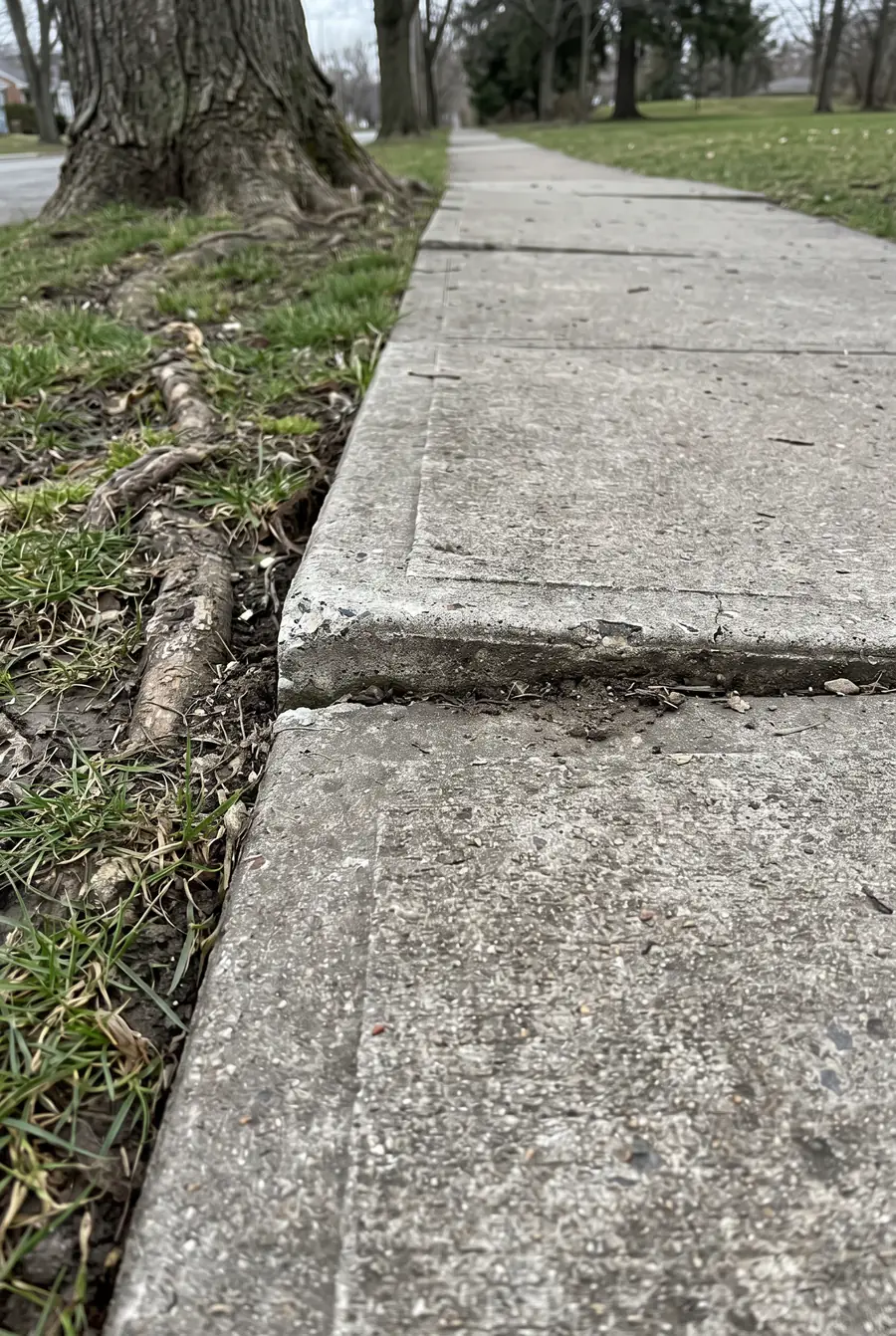
- It went down, not up. The low side is where support washed out or compressed.Pushed up by a tree root or by frost: no lift pushes a slab down, and the root is still there.
- There is a void underneath. A gap shows at the edge, soil has washed out beside it, or it sounds hollow when tapped.No void and the slab sits tight on the ground: it may have been poured that way, which is a regrading or replacement question.
- You can fix what caused it. A downspout, a low spot or an open joint against the house is sending water under it.Water you cannot redirect: expect the slab to settle again.
- It is flatwork, not the house. Walk, patio, stoop, driveway or garage floor.Cracks in the foundation, doors sticking, a corner of the house dropping: that is a foundation repair specialist's job, not a slab lifting job.
Six yeses: the slab is a reasonable lifting candidate, and lifting is usually the cheaper fix. Any no in the first three: lifting is the wrong tool. A no on four or five: fix the ground and the water first, then decide.
Sunken Sidewalk Square
- Lift if
- It is a private walk, one solid square, with a lip at the joint.
- Replace if
- It is cracked into pieces, scaled, or heaved by a root.
- Start with
- On the public walk by the street, the city, before anyone else. See below.
Patio Slab Sloping Toward the House
- Lift if
- The patio is one piece and the house side dropped onto loose backfill.
- Replace if
- It is broken up, or was poured flat or backward from day one.
- Start with
- The downspout nearest it. Water sent at the house is the urgent part.
Settled Driveway Slab or Apron
- Lift if
- One section dropped as a unit, and the rest of the driveway is sound.
- Replace if
- Several sections are broken, or the surface is scaling across the drive.
- Start with
- Where the water goes. An apron on the parkway also falls under city right of way rules.
Stoop Pulled Away From the House
- Lift if
- It is solid poured concrete that tipped as one block.
- Replace if
- It is a brick or block shell with a thin cap, or cracked through.
- Start with
- How settled stoops and worn steps get fixed, including which stoops can be lifted.
Sunken Garage Floor Section
- Lift if
- The dropped section is one piece with a void under it.
- Replace if
- That part of the floor has broken into pieces.
- Start with
- How sunken sections of a garage floor get leveled and when they get cut out.
Settled Alley Approach Slab
- Lift if
- It is one sound panel, it is yours to fix, and the work is cleared with the city.
- Replace if
- It is broken up by trucks, plows and runoff from the alley.
- Start with
- A call to 311. Work in Evanston's right of way needs a city permit, and street and improved alley openings stop from November 15 through March 31.
Mudjacking vs Polyurethane Foam Lifting
The two methods you will be quoted for. Both drill through the slab, pump material underneath, and patch the holes. The material is the difference.
| Mudjacking (slab jacking) | Polyurethane foam lifting | |
|---|---|---|
| What goes under the slab | A cement based slurry; recipes vary and can include sand, soil or lime | A two part foam that expands as it reacts and hardens |
| Drilled hole size | About 1.5 to 2 inches | About 1/2 to 5/8 inch |
| Weight added to the soil | Heavy; the slurry adds load to the ground that already settled | Very light; the slab lifting foam data sheet we checked lists 4 pounds per cubic foot |
| Cure before use | About 24 hours | About 15 minutes |
| Water | A wet slurry; can wash out or soak into the soil around it over time | Closed cell foam that absorbs very little water |
| National cost range | $4 to $9 per square foot | $8 to $25 per square foot |
Hole sizes, cure times and cost ranges: HomeGuide's mudjacking cost guide (updated November 2025), national figures, not a local quote. Foam weight and water absorption: Huntsman's Geolift 4.0 slab lifting foam technical data sheet (4.0 lb/ft³ density, water absorption of 1% or less). Slurry behavior: Missouri DOT interim report on polyurethane slab lifting, 2000.
How Mudjacking Works
Mudjacking is the older method, and it is still the cheaper one per square foot. Holes are drilled through the sunken slab, and a cement slurry is pumped in under pressure until it fills the void and floats the slab up. The Missouri Department of Transportation, describing its own cement, lime and water mudjacking mix, noted that the slurry's high water content can be absorbed into the surrounding soil, and that several rounds of mudjacking are generally needed to reach the target height. That is a highway agency talking about pavement, but the physics is the same under a front walk.
How Polyurethane Foam Slab Lifting Works
Foam lifting injects two liquids through small holes, and they react under the slab into a rigid foam that expands, fills the void and pushes the concrete up. The foam weighs a small fraction of a slurry, so it adds almost no load to soft ground, and it is ready for traffic quickly; Missouri DOT reported 90% of compressive strength within 15 minutes. It costs more, and it needs an installer who raises the slab in small, controlled steps, because a slab pushed up unevenly can crack.
Neither method is a cure for a slab that does not qualify, and neither is the answer to every quote. When a lifting company tells you which material it uses, ask how it plans to keep the slab from cracking during the lift, how the holes get patched, and what happens if the slab settles again.
Why Concrete Sinks in Evanston Yards
Concrete does not sink on its own. Something under it compressed, washed away or froze, and the slab followed the ground down. Knowing which one it was tells you whether lifting will last.
Washed Out Base Under the Slab
Water running under the edge of a slab carries fine soil away with it, a little each storm, until there is a void. The usual sources are a downspout emptying beside the concrete, a yard that drains toward the slab instead of away from it, and an open joint where the slab meets the house. If you can see a gap or eroded soil along the edge of a sunken walk or patio, this is your cause, and it has to be stopped before or along with any lift.
Loose Backfill Beside the Foundation
When a house is built, the trench around the foundation is backfilled, and in residential work that fill is rarely compacted in thin, tamped layers. It settles slowly for years. Patios, stoops and walks poured against the house sit right on top of it, which is why the house side of a slab is so often the side that drops, tipping it toward the foundation.
Clay Soils, Fill and Freeze and Thaw Under Concrete
USDA soil mapping shows sandy ground along the Ridge and the lakefront, heavier clay inland and in north Evanston, and much of the city as urban fill. Sand drains. Clay holds water and moves with it, and old fill settles at its own pace. On top of that, Evanston's adopted residential code puts the local frost depth at 42 inches, while a walk or patio rests on a few inches of base, so the ground under flatwork freezes every winter. A slab that rises in February and drops in April is being moved by frost, and lifting it in the spring only catches it at one point in that cycle.
What Concrete Leveling Can't Fix
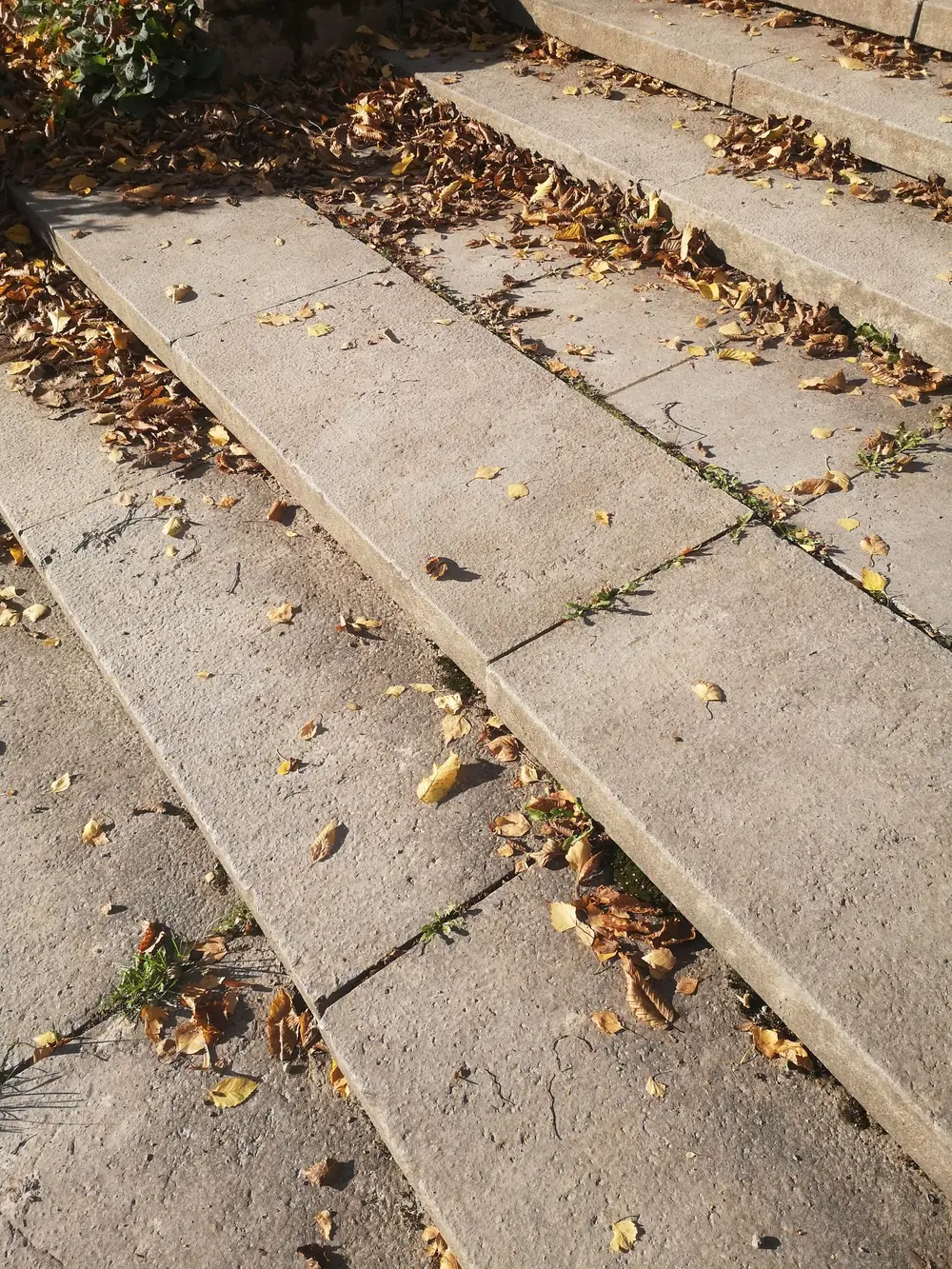
Lifting corrects height. It does not repair concrete, and it does not change the ground. These problems need something else:
- A slab broken into pieces. Each piece lifts on its own and the cracks between them stay. Cut the section out and replace it.
- Scaling and spalling. A flaking surface is still flaking at the right height. Our guide to cracked, scaled and sunken concrete covers which surface damage can be patched.
- A slab heaved by a root. It has to come down, and in Evanston any exterior work within 25 feet of a tree, roots included, needs the city's Tree Preservation Permit.
- A hollow stoop. Brick or block shells with a concrete cap cannot be lifted.
- A slab that was poured with the wrong pitch. If it never drained away from the house, raising it to its original height changes nothing.
- A settling house. If the foundation is moving, the slabs around it are a symptom. Foundation settlement is a foundation repair specialist's job, and it comes first.
Cracks also stay visible after a lift. A sunken slab usually cracked as it went down, and lifting closes the height difference, not the crack. A flexible sealant in that crack afterward keeps water out.
How Long Does Slab Jacking Last?
As long as the ground under it stays put, and that is the honest answer to the question every lifting company gets. HomeGuide's cost guide says properly done mudjacking lasts 5 to 10 years or longer, depending on soil and drainage, and that the result depends more on fixing the cause of the settling than on the lift itself. We agree with that order of importance.
Lifted slabs settle again for a few predictable reasons. The water that washed out the original void is still running under the edge. The soil below the new material keeps compressing, which matters more with a heavy slurry on soft ground. Freeze and thaw keep working on wet soil every winter. Or the void was not completely filled, and the slab finds the empty spot later.
Fix the Water Before the Concrete Lift
Before you pay anyone to lift a slab, take care of the water that is going under it. Extend downspouts so they empty well past the concrete. Regrade low spots so ground beside the house falls away from it; the residential code calls for at least 6 inches of fall in the first 10 feet where the lot allows. Seal the joint where a patio, walk or stoop meets the foundation with a backer rod and a flexible sealant. A lift done after those fixes has a real chance of staying where it was put.
Mudjacking Cost and What Drives It
We do not quote slab lifting, so these are national published figures, not our prices and not a quote for your slab. They are useful for knowing whether a bid is in the normal range.
| Item | National range | Source |
|---|---|---|
| Mudjacking | $4 to $9 per square foot | HomeGuide |
| Polyurethane foam lifting | $8 to $25 per square foot | HomeGuide |
| Typical minimum job charge | $300 to $700 | HomeGuide |
| Mudjacking a 100 square foot sidewalk | $400 to $900 | HomeGuide |
| Concrete leveling, national average job | $1,174 (typical range $630 to $1,723) | Bob Vila, citing Angi and HomeAdvisor |
| Full slab replacement, for comparison | $6 to $15 per square foot | HomeGuide |
What moves the number on any lifting estimate:
- The size of the void, more than the size of the slab. Material is the main cost, and a deep washout takes a lot of it.
- The method. Foam costs more per square foot than slurry, and saves on holes, weight and waiting time.
- The minimum charge. One sunken square and four sunken squares need the same truck and pump, so price everything on the property in one visit.
- The extras. Downspout and grading work, sealing the joints and cracks, and patching the holes may or may not be in the price. Ask.
- The slab itself. A thick driveway slab or a stoop needs more lift pressure and more care than a walk.
Here is the admission that costs us something: when a slab passes the checklist above, lifting is usually the cheaper fix, and the money you save by not replacing it is real. HomeGuide puts the saving at 30% to 50% compared with tearing out and replacing the concrete. It is a bad buy only when the slab fails the checklist, because then you pay for a lift and, a few years later, the replacement as well.
Sidewalk Leveling in Evanston: Public Squares vs Your Own Walk
Most sidewalk leveling questions in Evanston are really about the public walk between the street and the yard. That walk sits in the city right of way, the city sets the rules for it, and city code makes the adjacent owner responsible for its upkeep. So before anyone drills a public square, the call to make is to 311, at 311 or (847) 448-4311.
The city's tools are replacement, not lifting. Under the 50/50 program, a square that has sunk or risen to a height difference of half an inch or more, tilted abruptly, broken into three or more pieces, or scaled across a third of its surface qualifies to be replaced, with the city paying half. For 2026 the homeowner share was $8.40 per square foot, or $222.60 for a typical square, and signups for 2026 have closed. Where a square cannot be replaced right away, the city's sidewalk program page says its Streets Division will put in a temporary asphalt repair until the square can be permanently replaced, and it warns that the backlog may take several years. Our page on replacing sidewalk squares through the 50/50 program explains signup, criteria and private replacement.
On your own front path or side walk, the choice is yours. A small sunken square that passes the checklist is a classic job for a lifting company, and it may be all the walk needs. A run of broken, scaled or root lifted squares is a replacement.
DIY Concrete Leveling: What You Can Actually Do
There is no real do it yourself version of lifting a slab. Mudjacking needs a slurry pump and foam lifting needs a heated, high pressure rig, and pushing a slab up unevenly is how a sound slab gets cracked. That still leaves the most useful part of the job for you.
Homeowner Fixes Before Concrete Lifting
- Downspouts. Add extensions so roof water lands well past the slab, not beside it.
- Grading. Fill low spots so soil falls away from the house and away from slab edges.
- Joint sealing. Clean out the joint where the slab meets the house, add backer rod, and seal it with a flexible sealant.
- Mark the hazard. Paint the lip on a sunken square so nobody catches a toe, and report a public one to 311.
- Watch it. Check the slab in winter and again in summer. Movement that comes and goes is frost, not settling.
What a Bag of Concrete Leveler Does
Products sold as self leveling concrete or floor leveler fill low spots in a surface. They raise the top, not the slab, and do nothing about the void underneath. On a sunken exterior slab, a thin layer feathered up to meet the neighbor tends to crack and pop loose after a winter of freeze and thaw and salt.
Expanding foam from a can is not lifting foam either. It is made for sealing gaps in walls, not for carrying a slab.
Not sure whether your slab passes the checklist?
Text a photo with something in the shot for scale. We will tell you whether it looks like a lifting candidate, which means a call to a lifting company, or a replacement.
(847) 380-8138Lift or Replace the Slab? Where Our Work Fits
We are a flatwork contractor. When a slab is too broken, too far gone or the base is washed out, replacement is what we do. A sound, settled slab is often a lifting specialist's job, and we would rather send you there than sell you new concrete you do not need. The related work on this site:
- Garage floor repair, which includes leveling sections of a garage floor that have sunk, and cutting out the ones that have broken.
- Concrete steps and stoops, including leveling stoops that have sunk away from the house, and repouring the ones that cannot be saved.
- Sidewalk square replacement, for public squares through the city's 50/50 program and private walks that miss it.
- Driveway replacement, built on a corrected base when the old driveway has failed from the bottom up.
Text a photo to (847) 380-8138 or use the form. Leave the service menu on Not Sure and describe what sank and where.
Get a Free Estimate
Tell us about the project and we will get back to you within one business day. Prefer to talk? Call or text (847) 380-8138.
Concrete Leveling Questions
Usually, when the slab qualifies. HomeGuide's national cost guide says mudjacking often costs 30% to 50% less than tearing out and replacing the concrete. The saving disappears when the slab is broken, scaled or sitting on ground that will keep washing out, because then you pay for a lift and a replacement.
Sooner than on new concrete. HomeGuide lists the cure time for mudjacking slurry at about 24 hours and for polyurethane foam at about 15 minutes, and a Missouri Department of Transportation report on foam lifting says the foam gains 90% of its compressive strength within 15 minutes. Ask the lifting company for its own wait time before you park on it.
Yes. The holes are patched with a cement grout, and the patch rarely matches weathered concrete. Foam holes are smaller, about 5/8 inch in the Missouri DOT report and roughly 1/2 to 5/8 inch in HomeGuide's comparison, against about 1.5 to 2 inches for mudjacking, so they are easier to live with on a front walk or patio.
Yes. Lifting fills the void, but it does not stop whatever made the void. If a downspout, poor grading or a leaking joint keeps washing soil out, or the soil below keeps compressing, the slab can drop again. Fix the water before the lift and the lift has a much better chance of lasting.
It is a poor season for it. The polyurethane lifting foam data sheet we checked calls for ambient and substrate temperatures above 32 degrees, and in a hard winter the ground under a slab can be frozen and heaved, which makes it hard to tell what has really settled. Note the problem, keep salt and meltwater off it, and get it looked at after the thaw.
Not as a general service. Our garage floor repair work includes leveling sections of a garage floor that have sunk, and our step work includes leveling stoops that have sunk away from the house. For a settled walk, patio or driveway that passes the checklist on this page, a slab lifting company is usually the cheaper and better call. When the slab is broken, too far gone or the base has washed out, replacement is the work we do.
Sunken Slab? Find Out Which Kind Before You Pay for Either
Evanston Concrete Co is a concrete contractor in Evanston serving the North Shore. Send a photo and we will tell you straight whether it is a lift, a replacement, or a job for a different trade.
(847) 380-8138