Exposed Aggregate Concrete in Evanston: Driveways, Patios and Walks
Exposed aggregate concrete is ordinary structural concrete with the top skin of cement paste washed away, so the stone inside shows at the surface. We pour it for driveways, patios, walkways, landings and accent borders across Evanston and the North Shore. Below: how it is made, which stone to pick, how it handles salt and shovels, what it costs against broom and stamped, and when one of those is the better buy.
Broom finish
- Pick it if
- You want the lowest price and close to zero upkeep.
- Skip it if
- Leaf stains, tire marks and plain gray bother you.
Exposed aggregate
- Pick it if
- You want grip, texture and a surface that hides dirt, for a moderate step up in price.
- Skip it if
- You never want to think about a sealer, or you go barefoot on it with sharp stone.
Stamped and colored
- Pick it if
- You want slate, brick or stone patterns and color.
- Skip it if
- Nobody will reseal it every two to three years.
What Is Exposed Aggregate Concrete?
Every concrete slab is mostly stone held together by cement paste. On a broom finished slab, the paste is on top and the stone stays hidden. With exposed aggregate, the paste is taken off the surface before it hardens, leaving the tops of the stones showing. People also call it a washed aggregate finish or pebble finish concrete. The Portland Cement Association (PCA) describes the result as rugged, slip resistant and highly immune to wear and weather.
There are two decisions behind it: how the decorative stone gets into the surface, and how the paste comes off.
| Step | Option | What it means for you |
|---|---|---|
| Getting the stone there | Seeded aggregate | The slab is poured, then decorative stone is spread on top and floated in. Concrete Network calls this the most commonly used method. You choose the stone without paying for a whole truckload of it. |
| Getting the stone there | Mixed through the batch | The decorative stone is in the mix itself. PCA calls this the monolithic method. It uses more decorative stone, so it costs more, but there is no seed layer to embed. |
| Revealing the stone | Surface retarder, then wash | A retarder sprayed on the fresh slab keeps the top layer of paste from setting. That layer is washed off hours later, while the slab underneath hardens normally. |
| Revealing the stone | Brush and hose, no retarder | The paste is brushed and rinsed off by hand as the slab stiffens. Concrete Network says the timing is critical, so this suits small jobs. |
| Revealing the stone | Blasting hardened concrete | Sandblasting, water blasting or shotblasting once the concrete is hard. PCA notes that sandblasting can dull the stone. It is mostly used on old slabs and commercial work. |
The stone you see is only the top third or so of each piece. PCA and Euclid's retarder guide both say the depth of exposure should not exceed one third of the average stone size. That is what keeps each stone held in place.
Exposed Aggregate Driveway: Traction, Road Salt and Plows
A driveway is the hardest test for any finish, and an exposed aggregate driveway passes it when it is built as winter concrete first and decoration second.
Air-Entrained Concrete Under the Aggregate
The stone on top does nothing for freeze-thaw if the concrete under it is wrong. PCA says exposed aggregate concrete that will see freezing, thawing and deicing salt should be air entrained, with 5% to 8% total air and a water-cement ratio no higher than 0.45. Our exterior mixes are air entrained, as on every driveway we pour, because Evanston's adopted code rates the area severe for weathering. A decorative finish does not change that mix. It sits on it.
Road Salt and Popouts on an Exposed Aggregate Driveway
Salt scaling is a surface paste problem, as our sealing guide explains, and on an exposed finish the paste is the thin layer between the stones. A stone with too little paste around it can let go. Three things cut that risk. Expose shallow, within PCA's one-third rule. Use a stone that holds: PCA warns that flat pieces and slivers do not hold well and that some stones crumble with repeated wetting and drying. And keep it sealed, which Concrete Network says helps protect against freeze-thaw damage and deicing salts. The rest is the same advice as for any slab: no deicers the first winter, and never ammonium-based products. Our concrete sealing guide covers the deicer rules in detail.
Shovels and Plow Blades on Exposed Aggregate
The stones stand a little proud of the paste, so a steel shovel or plow edge rides across hundreds of small bumps instead of a flat surface. A plastic shovel and a plow blade set to float just above the slab are kinder to it. Expect that a steel edge dragged hard all winter will eventually knock out a stone here and there, mostly near joints and edges. In exchange you get the grip that is the reason to choose this finish for a sloped drive in the first place.
Exposed Aggregate Driveway Looks Over Time
This is where exposed aggregate earns its price on a driveway. A busy stone surface hides drips and leaf stains far better than flat gray, which shows every one. What it will not hide is a repair. A patch in exposed aggregate rarely matches, which our concrete repair guide is honest about, so good jointing up front matters more here than on a broom slab.
Where an Exposed Aggregate Driveway Meets the Parkway
The last stretch of an Evanston driveway usually sits in the public right of way, and work there needs a separate city permit and an inspection before the pour. The city's permit page does not spell out finishes for that strip, so we confirm the finish with the city at permit time rather than guess. The permit and timing rules are on our driveway page.
Exposed Aggregate Stone and Color Choices
The stone decides the color, the feel underfoot and how well the finish holds. PCA and Concrete Network both name the same core list. What you can actually get depends on what local yards carry that season, so we show you samples from current stock rather than promise a catalog.
Pea Gravel and River Rock Aggregate
Rounded stone in mixed tans, grays and browns: the classic pebble finish. PCA says 3/8 inch pea gravel is commonly used for driveways, sidewalks and patios. Rounded stone is the comfortable choice underfoot.
Granite Aggregate
Speckled grays, pinks and blacks. PCA and Concrete Network both list granite among the popular decorative stones. It is hard and holds its color.
Quartz Aggregate
White to translucent, for a bright surface. PCA rates quartz at 7 on the Mohs hardness scale, which makes it one of the hardest options.
Limestone Aggregate
Soft grays and buffs, and the local stone. The Illinois State Geological Survey says the state's aggregate comes from limestone and dolomite bedrock and from river, beach and glacial sand and gravel, and Ozinga, a Chicago-area supplier, lists crushed limestone as commonly used in ready mix. One caution from PCA: limestone and dolomite discolor and dissolve in muriatic acid, so no acid wash on this stone.
Basalt and Dark Trap Rock Aggregate
PCA says trap rocks such as basalt give gray, black or green colors. Dark stone makes the strongest contrast for bands and borders, like the diamond walk pictured further down.
Recycled Glass Aggregate
Seeded into the surface for color accents. PCA says glass aggregate should come with the producer's assurance of low reactivity with portland cement, because some glass reacts badly with cement. We use it as an accent, not the whole surface.
Two practical points. Rounded and crushed stone look and feel different. PCA notes crushed stone tends to stack and can have sharp edges, so it reads more angular and grips more, but it is the wrong pick where people go barefoot. And PCA warns against stone carrying iron oxides or pyrite, which can leave rust stains on the surface. A reputable supplier's washed decorative stone is the safe route.
For a road-tested stone, Illinois has a long record. The Illinois Department of Transportation runs freeze-thaw tests on aggregate sources for road and bridge work. That record began after D-cracking on interstate pavement traced back to some aggregate sources. Seed stone for a driveway should come from the same kind of durable source.
Exposed Aggregate vs Broom Finish vs Stamped: Which to Pick
Same slab, same base, same air-entrained mix. The finish changes the surface, the upkeep and the price.
| What matters | Exposed aggregate | Broom finish | Stamped and colored |
|---|---|---|---|
| Grip | Excellent; the stone is the texture | Good while the ridges last | Depends on the pattern and sealer; grit additive recommended |
| Hides leaf stains and drips | Best of the three | Shows everything | Busy patterns hide a lot; color can fade |
| Upkeep | Sealer every few years recommended | Optional sealer; essentially none | Reseal every 2 to 3 years to hold color |
| If upkeep is skipped | Loses its wet look; may lose a stone here and there | Little changes | Color fades and salt reaches the surface |
| Finishing labor on pour day | More: seeding, retarder, a return trip to wash | Least | Most: color layers, mats, detailing |
| Patches | Rarely match | Visible but cheap | Visible |
| Barefoot comfort | Good with small rounded stone; poor with sharp crushed stone | Fine | Fine |
The honest version, even where it costs us a bigger job. If the buyer wants zero maintenance and the lowest price, broom wins, and we will pour it happily. Exposed aggregate takes more labor than broom on pour day: the stone, the retarder, and a crew coming back to wash it. You pay for that. Stamped asks the most of you afterward, and our stamped concrete page is upfront about its resealing schedule. Exposed aggregate sits in the middle on both counts. A smart split is a broom field with exposed aggregate borders or landings, covered below.
How an Exposed Aggregate Finish Is Made on Pour Day
This is the retarder method, with stone seeded into the surface. Times come from the manufacturers' data sheets and shift with heat and humidity, which is why the wash crew watches the slab, not the clock.
-
Before the truck
Base, Forms and Joint Layout for Exposed Aggregate
Excavation, compacted base, forms and reinforcement are the same as for any slab. What changes is planning: you pick the stone and decide where bands, borders and joints go, because joints are hard to hide in a patterned stone surface.
-
Pour
Placing and Seeding the Aggregate
For a seeded finish, PCA describes striking the slab off slightly low, spreading the decorative stone evenly, and tapping it in with a float until paste just covers every stone, about 1/16 inch. Euclid warns against rollers, jitterbugs and over-floating, which drive the stone too deep.
-
As the sheen goes
Spraying the Surface Retarder
W.R. Meadows says to spray its TOP-STOP retarder with a low-pressure sprayer once the concrete has lost its sheen and finishing is done. Euclid times its product to about when you would broom an exterior slab. Some retarders need plastic or wet burlap on top; others form their own protective skin.
-
Hours later to next day
Washing the Retarder Off the Aggregate
The top paste comes off with a hose and stiff broom, or a pressure washer later in the window. Dayton Superior's TOP-CAST sheet says as early as 4 hours and up to 16, sooner in hot weather. W.R. Meadows and Euclid give 12 to 24 hours. Too early and stones come loose; too late and the paste has set and won't wash off.
-
The next week
Curing the Exposed Aggregate Slab
PCA's guide specification starts curing as soon as washing stops and keeps the concrete moist for 7 days. Some systems use a cure-and-seal product after the wash instead. If a light cement haze is left, PCA says an acid wash is optional, not required. On limestone it is a bad idea anyway.
-
After the cure
First Sealer Coat on Exposed Aggregate
Concrete Network says to seal exposed aggregate after curing is complete. The section below covers which sealer and how often.
Process from PCA's Finishing Concrete Slabs with Color and Texture (PA124), W.R. Meadows TOP-STOP (August 2022), Dayton Superior TOP-CAST (2023), Euclid Chemical's Increte EZ Expose best practices (2025) and Concrete Network. Your crew's product may differ; its data sheet rules.
Exposed Aggregate Patios, Walkways and Pool Surrounds
Exposed Aggregate Patio Next to the House
On a patio, the finish works where a back door meets wet grass: it grips when wet and hides the leaf and drip stains that shaded Evanston backyards collect under mature trees. Everything else about the patio, including sizing, slope away from the foundation and the isolation joint at the house, is the same as any concrete patio. One Evanston point: exposed aggregate is solid concrete, so it counts fully toward your lot's impervious surface cap, with no permeable discount.
Exposed Aggregate Walkway and Landing
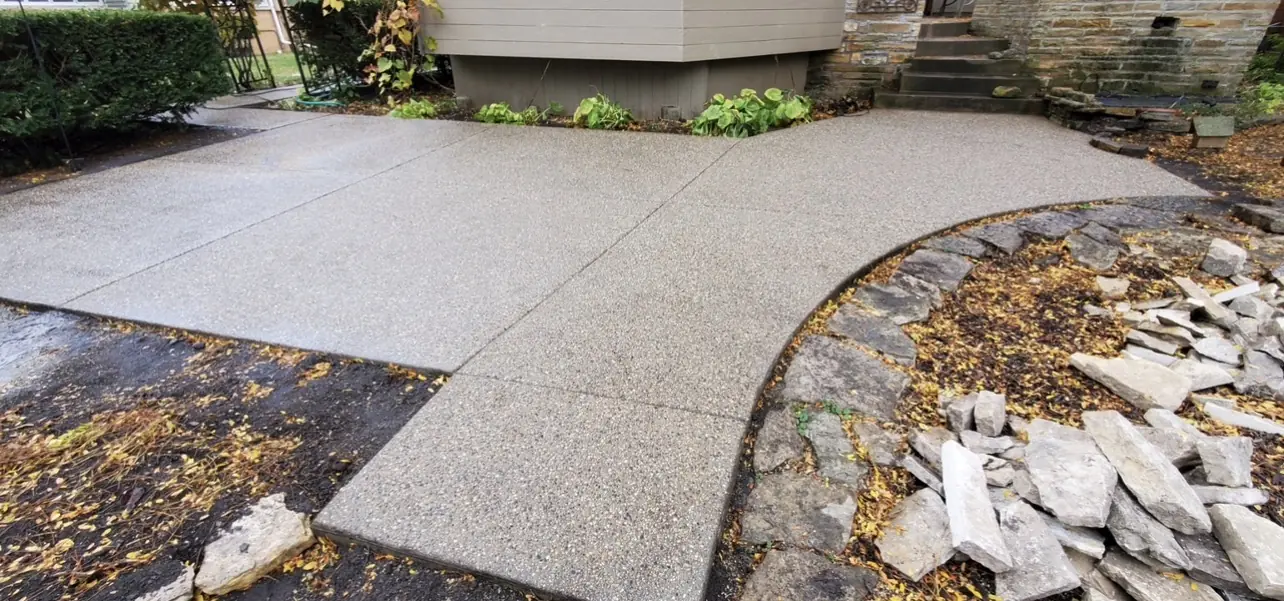
Front walks and landings are where the finish gives the most for the money: small square footage, seen every day, walked in every weather. It pairs well with a contrasting smooth troweled edge, as in the photo. Public sidewalk squares in the parkway are a separate city matter, covered on our sidewalks and walkways page.
Pool Surrounds in Exposed Aggregate
Here the stone choice matters most. PCA says sharp, angular crushed aggregate should be avoided in barefoot areas such as pool decks. Use small rounded stone, exposed lightly. If the deck is sealed, add grit so wet feet keep their grip.
Exposed Aggregate Borders, Bands and Diamond Layouts
You don't have to finish the whole slab in stone. We pour exposed aggregate as borders around broom or stamped fields, as bands between smooth panels, and in diamond and grid layouts. You pay for decorative finishing on the bands, not the whole slab.
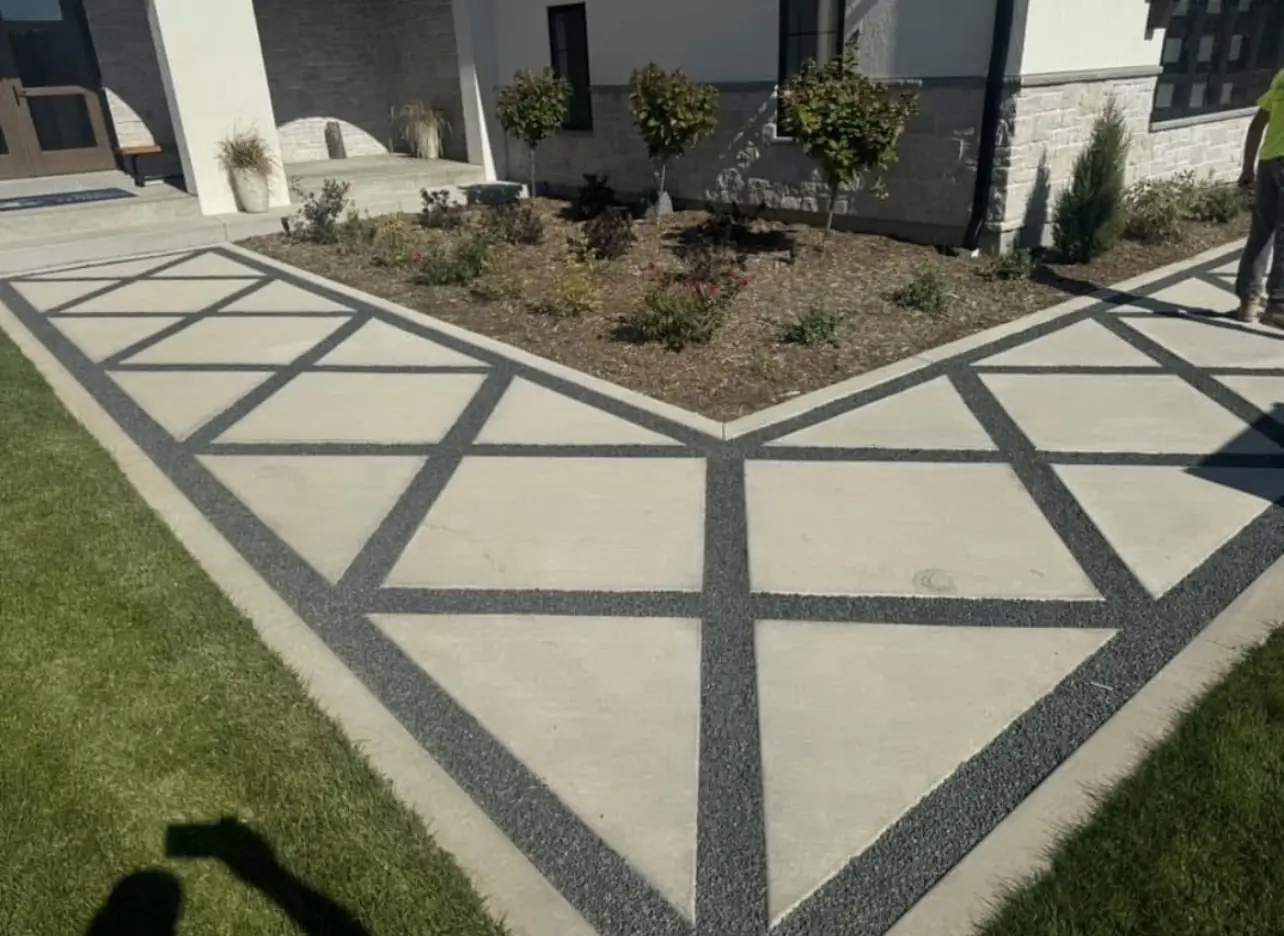
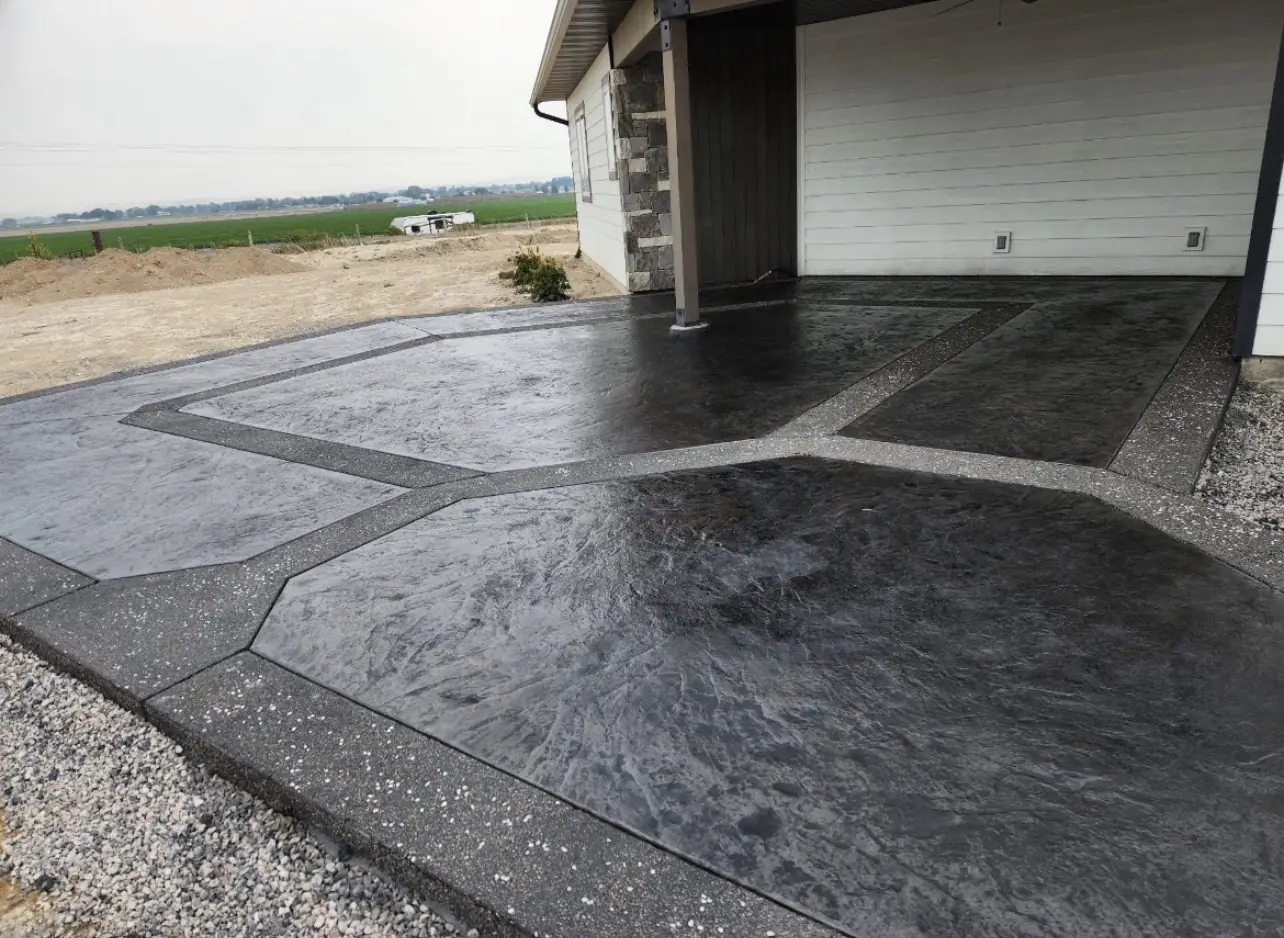
Banded layouts have a practical side. The band is a natural place for a control joint, so the shrinkage cracking every slab does happens along a line you designed instead of across a panel. Dark basalt bands against light panels give the strongest contrast. Pebble bands on gray read quieter and suit older houses.
In Evanston's four local historic districts, Lakeshore, Ridge, Northeast Evanston and the Woman's Christian Temperance Union district, permitted exterior work visible from the public way needs a Certificate of Appropriateness. The city's application lists new patios, terraces and walkways as sitework. It also asks for samples or brochures when a replacement material isn't an exact match to the original. A sample board of the stone helps that review. Our decorative concrete page covers how we plan district projects around the review.
Deciding between a full stone surface and borders?
Send a photo of the area and a rough size. We will price exposed aggregate everywhere, borders only, and plain broom, side by side in writing.
(847) 380-8138Resealing and Upkeep for Exposed Aggregate
The first sealer coat goes on after the cure. After that, the published intervals cluster around every few years: Concrete Network says every few years as needed, and at least every couple of years for patios in freezing climates, and Ozinga says every three to four years. That is a little looser than the two to three years stamped concrete needs. The bigger difference is the cost of skipping it. Exposed aggregate mostly loses its wet look and some stain resistance, while stamped color fades.
- Penetrating or film. PCA lists methyl methacrylate, silane and siloxane sealers for exposed aggregate, and warns that linseed oil may darken the paste. Quikrete calls its silane-siloxane sealer particularly suitable for exposed aggregate. A penetrating sealer keeps the stone texture and its grip. A gloss film gives the deep wet look, but it fills the gaps between stones and gets slick on a slope.
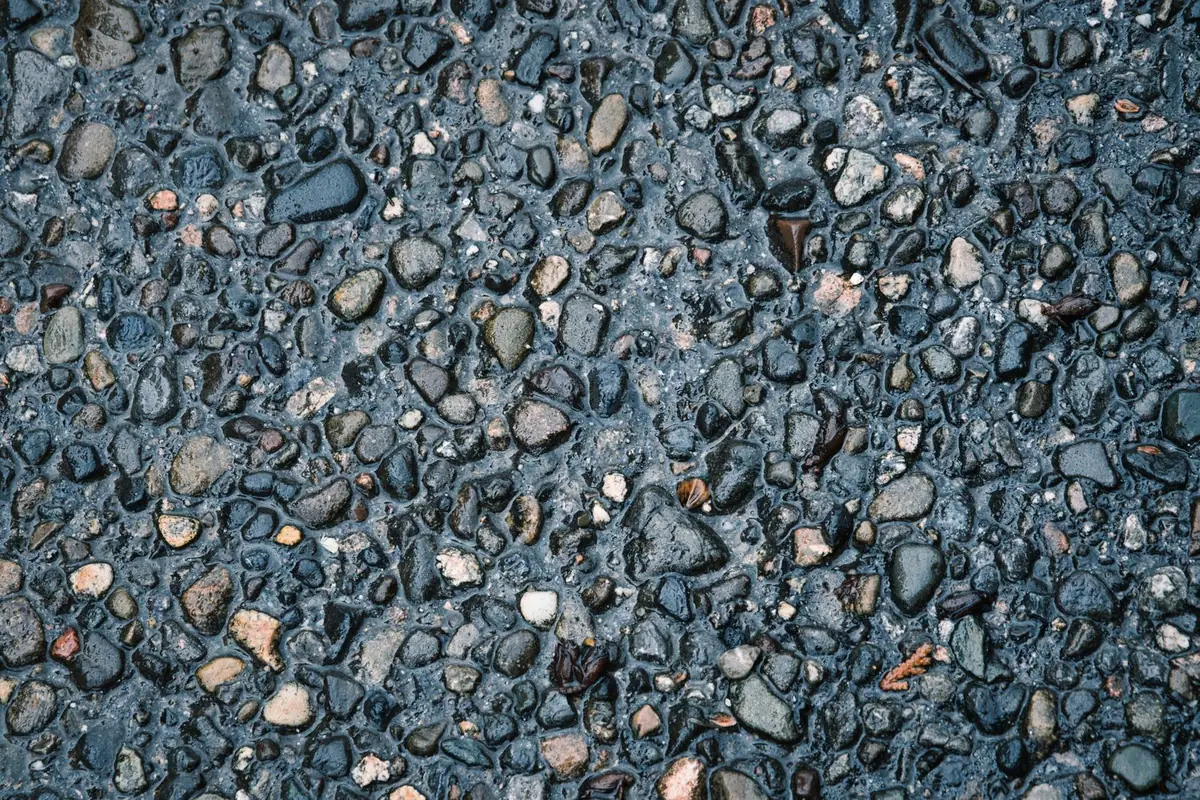
- Test a corner. Any darkening sealer changes the stone color for good, as the close-up at the top of this page shows when wet.
- Who does it. On a new pour we tell you when the slab is ready for its first coat. Resealing later is a homeowner or sealing-company job; we don't take stand-alone sealing work. Product types, temperature windows and published sealing costs are in our concrete sealing guide.
- Cleaning. A hose and stiff brush handle most dirt. Skip acid cleaners on limestone aggregate.
Exposed Aggregate Concrete Cost vs Broom and Stamped
These are published national figures from named cost guides, not our prices and not a quote for your job. They are most useful for comparing finishes side by side from the same source.
| Source | Exposed aggregate | Same source, other finishes |
|---|---|---|
| Fixr, concrete driveway cost, updated January 2025 | $8 to $12 per square foot for an exposed aggregate driveway | Plain $6 to $8; broom finished $8 to $12; stamped $12 to $18 per square foot |
| Concrete Network, driveway cost, updated January 2026 | Exposed aggregate falls in its basic decorative tier, $8 to $14 per square foot | Plain $5 to $8; mid-range such as stamping $14 to $21 per square foot |
| Concrete Network, walkway cost, updated May 2020 | Exposed aggregate falls in its basic tier, $6 to $10 per square foot | Mid-range $8 to $12; high end $12 and up per square foot |
| Bob Vila, concrete patio cost, updated August 2023 | An aggregate finish adds $2 to $3 per square foot | A broom finish is often free of cost |
The sources agree on the order, and that matters more than any single number: plain at the bottom, exposed aggregate a step up, stamped above that. Fixr puts its exposed aggregate and broom finished driveway ranges at the same $8 to $12. Treat that as a sign of how wide national ranges are, not as proof the two cost the same to finish.
What moves an exposed aggregate bid in Evanston:
- Seeded or mixed through. Concrete Network says mixing the decorative stone through the batch costs more than seeding, because it takes much more stone.
- The stone. Whatever local yards stock is the economical route; a specialty stone or glass shipped in for one job adds material cost.
- Full surface or bands. Borders and bands put the extra labor on a fraction of the area.
- Pour-day logistics. A retarder pour needs a crew back on site hours later or the next day to wash it, plus water and a place for the rinse water to go.
- Everything under it. Tear out, haul away and base correction cost the same as for a broom slab. On inland Evanston clay that can outweigh the finish, as our driveway page explains.
Exposed Aggregate Questions
Bare, it is one of the grippier finishes you can walk on. The Portland Cement Association calls exposed aggregate finishes rugged and slip resistant. What changes that is a glossy film sealer that fills the spaces between the stones, so on a sloped walk or driveway pick a penetrating sealer or add grit to a film one.
Not the way new work is made. Retarders and washing only work on fresh concrete, in the hours after the pour. On hardened concrete, PCA lists sandblasting, water blasting and shotblasting, and notes that sandblasting can dull the stone. On an old slab, those methods can only uncover whatever ordinary stone was already in the mix, and they will not hide cracks or heaving. If the old slab is sound and only the top is worn, read our resurfacing guide first. If it is failing, a new exposed aggregate pour is the real answer.
A few can, and you can keep it to a few. The rule PCA and Euclid both give is to expose no deeper than one third of the average stone size, so most of each stone stays locked in the concrete. Washing too early knocks stones out. Concrete Network says a longer retarder window lets the concrete harden and cuts popouts. PCA also says flat pieces and slivers do not hold well, so pick a stone shape that holds, and seal on schedule so salt water is not working at the paste around the stones.
It can be, if you choose the stone for it. PCA says sharp, angular crushed aggregate should be avoided in barefoot areas such as pool decks. Small rounded pea gravel, exposed lightly, is the kinder choice. If the pool deck will be sealed, ask for grit in the sealer, the same way our stamped page handles pool surrounds.
Yes. It is solid concrete, and Evanston's zoning sheet says solid concrete and asphalt get no discount toward the impervious surface cap: 45 percent in R1, 55 percent in R2 and 60 percent in R3. The stone on top does not make it permeable. Our patio page walks through the coverage math.
Published guidance clusters around every few years. Concrete Network says to seal after curing and again every few years, and in freezing climates at least every couple of years for patios. Ozinga says every three to four years. That is close to the two to three years we give for stamped concrete. The difference is what happens if you skip it. Stamped color fades, while exposed aggregate mostly loses its wet look and some stain resistance.
Price an Exposed Aggregate Pour
Tell us where it goes, roughly how big, and whether you are thinking full surface or borders. We will bring stone samples from current local stock, and the written estimate will show the stone, the method, the sealer plan and a broom alternative.
- Exposed aggregate driveways, poured on an air-entrained mix
- Patios, walkways and landings
- Borders, bands and diamond layouts around broom or stamped fields
Call or text (847) 380-8138, Monday to Friday 8am to 5pm, Saturday 9am to 3pm.
Get a Free Estimate
Tell us about the project and we will get back to you within one business day. Prefer to talk? Call or text (847) 380-8138.
Stone, Broom or Stamped? Get All Three Priced
Evanston Concrete Co is a concrete contractor in Evanston serving the North Shore. Ask for the finishes side by side and pick with real numbers in front of you.
(847) 380-8138